
'It is just an excuse to say that the Centre has run out of money.' 'Pruning these schemes would mean hard time for the people of India.'

Market participants are hoping for a few tweaks on the taxation front which will encourage consumers and businesses to spend.

'If an investor is ready to stay put for the next five years, one can consider investing in mid- and small-cap funds, but through SIPs.'
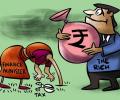
While the tax-to-GDP ratio of 9.88 per cent has been assumed for FY21, the same as last year, when it touched a decadal low, for FY22 a ratio of 10.7 per cent has been assumed, an average of the last five years.

Last year's Budget had created uncertainty about the quantum of tax to be withheld on dividends paid to non-residents, as the exact tax rate was not specified under section 195.

Outflows are likely to continue, experts say, till such time as the markets see a significant correction.

Equities in India saw record FPI inflows of $16.8 billion in November and December, taking the benchmark indices to new highs.

Indian equities are no longer cheap vis-a-vis global markets, and only a short distance away from being the most expensive they have ever been.

The country's m-cap is now 4.3x India's, whose m-cap grew just 17 per cent to $2.5 trillion in CY20 -- 2.4 per cent of the global m-cap.. Ashley Coutinho reports.
According to the new proposals, resident promoters or a foreign promoter from a FATF jurisdiction can set up a market infrastructure institution.

The unlocking of the economy since June led to a significant recovery in various macro, micro and high-frequency data points, resulting in the equity markets surpassing their previous lifetime highs.

The pre-Budget proposals sent to the finance ministry aim to bring uniformity in tax treatment for investments in different financial sectors, mitigate hardship to retail taxpayers, and encourage participation in mutual funds.

The new entrants comprise Asian Paints, Britannia, Titan, Nestl, Bajaj Finance and Bajaj Finserv.

Polarisation and the increase in index weight of a few a stocks have weighed on performance. The worst performers include Nippon India Large Cap and HDFC Top 100 (2.6 per cent).

'However, this time it looks like that is not working.'

The new PN3 norms and lack of clarity on what constitutes beneficial ownership are the primary reasons for the decline in investments from China and Hong Kong.

Assets under management of India-dedicated funds have slid 20 per cent in the year to November to $35.2 billion.

Fund managers may end up losing out on crucial information during market hours, leading to information asymmetry vis-a-vis other institutional investors such as alternative investment funds, insurance players, or foreign portfolio investors.

The robust revenue collection reinforces hope of a good economic performance in the third quarter of financial year 2020-21 after the surprising pickup seen in Q2.

While the amount collected is a tad lower than last two years, it may surpass the previous two years' collections by the end of the year.
 © 2025 Rediff.com - Investor Information - Advertise with us - Disclaimer - Privacy Policy - Sitemap - Feedback - About us - Terms of use - Grievances